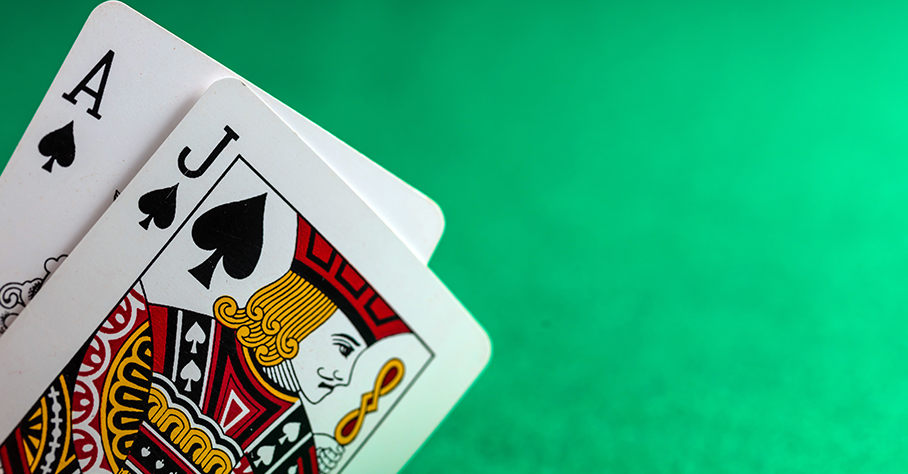
Blackjack is the star of the casino because it not only has the best overall odds for the player, but because it is the only game where what you see in the past changes the odds of winning or losing in the future. If played properly, the Casino house edge is only approximately .50%. When you factor in that decks get hot and decks get cold, a smart player can further move this percentage in their favor. Even without card counting, a skilled player can vary the size and timing of bets to win big. When things get rolling on blackjack it is like printing money.
For the novice or beginner player the goal of blackjack is for your hand to beat the dealer’s hand. The other players at the table do not factor into whether you win or lose (although they can influence the cards you get). The goal is not as simple as getting closest to 21 without going over, as sometimes the best strategy is to stand with a bad hand and potentially force the dealer to take a card in hopes the dealer will bust. Blackjack in-game play is all math-based depending on the cards in your hand and the one card of the dealer’s that you can see.
Based on mathematical models, and then later computer simulations of millions of hands, a formula has been established about what the player should do in each instance to maximize the player’s chance of winning. This formula takes into account that the dealer has no discretion on whether to hit or stand. If the dealer has below sixteen, it must hit. The house gets its advantage because the player must decide to hit or stand prior to the dealer acting. The result is that in many circumstances the player busts and loses before the dealer ultimately busts. Even though both the dealer and the player busted, the dealer wins as the player busted first. All basic blackjack strategy is based around this concept and the proven mathematical theory that the greater number of small cards left in the deck favors the dealer. This is because the dealer has a better chance to make a hand between 17 and 21 when it is forced to hit if the deck consists of a greater number of small cards. Larger cards will cause the dealer to bust.
So, you must begin by learning the strategy based on the rules in effect at the table you are playing. Rules vary from casino to casino and table to table. Typically, you get the best odds on tables with a higher minimum bet as sophisticated players will not play at tables with rules stacked against them. The best scenario for a player that can be typically found is a table that pays 3:2 on a player’s blackjack, allows for doubles after splits and up to four splits, requires the dealer to stand on soft 17 (Ace, 6), and allows a player to surrender. There are other rules that can benefit the player such as allowing a player to surrender prior to the dealer peaking. However, these rules are so rare they are not worth discussing. Also, the number of decks being used also influences the odds (and often the rules). For example, shoes with less decks will change the rules for surrendering and splitting to move the odds back in the casino’s favor. Once you determine the rules of the table, apply the correct strategy to those rules. Strategy cards can be searched and printed from the internet. The advantage is that you can carry these into the casino and refer to them while you play.
We typically play a six-deck shoe, non-continuous shuffle, surrender allowed, doubles allowed after splits, 3:2 blackjacks, and the dealer standing on soft 17. Sometimes you cannot find these rules. If we are forced to play without surrender and the dealer hitting soft 17, we may do so. But we will never play at a table with 6:5 blackjacks or the house not allowing doubles after splits. There are some slight variations on strategy if the dealer hits soft 17 or not, so strategy cards should be consulted. Assuming the typical rules set forth above, the basic strategy is as follows for each scenario:
Hard Hands (total amount does not include an ace or pairs):
17 and up, always stand
16 stand against dealer 2 through 6, otherwise hit
15 stand against dealer 2 through 6, otherwise hit
14 stand against dealer 2 through 6, otherwise hit
13 stand against dealer 2 through 6, otherwise hit
12 stand against dealer 4 through 6, otherwise hit (hitting a 12 against a dealer 2 or 3 is counter-intuitive but must be done)
11 double against everything except the dealer having an ace
10 double against everything except the dealer having a 10 or an ace
9 double against dealer 3 through 6, otherwise hit.
8 or below always hit, never double
Soft Hands (a player hand that consists of one ace)
Soft 20 (A,9) always stand
Soft 19 (A,8) always stand
Soft 18 (A,7) double against dealer 2-6, and hits against dealer 9, 10 and ace (hitting the soft 18 against the 9, 10 and ace is a difficult hit but must be done)
Soft 17 (A,6) double against 2-6, otherwise hit
Soft 16 (A,5) double against dealer 4-6, otherwise hit
Soft 15 (A,4) double against dealer 4-6, otherwise hit
Soft 14 (A,3) double against dealer 5-6, otherwise hit
Soft 14 (A,2) double against dealer 5-6, otherwise hit
Pairs (a had consisting of two of the same card)
Aces, always split
Tens, never split
Nines, split against 2,3,4,5,6,8, and 9. Stay against a dealer 7
Eights, always split
Sevens, split against 2-7, otherwise hit
Six, split against 2-6, otherwise hit
Fives, double (do not split) against 2-9 and not against 10 and Ace
Fours, split against 5 and 6, otherwise hit
Threes, split against 2-7, otherwise hit
Twos, split against 2-7, otherwise hit
Surrender Rules
16 (other than a pair of 8s) surrender against 9, 10 and Ace
15 surrender against 10 and Ace
These rules should always be followed and not varied. However, the amounts of your bets should vary. Assuming no card counting, varying the size of your bets, not chasing losses, and leaving the table if you are losing are the keys to wining big at blackjack. The way to vary your bets is, unfortunately, not a mathematical formula that can be put in a table but is instead based on what you have seen in the past in the shoe and “feel.” Those players that are 100% statistical based will tell you that there is no such thing as “feel” and varying your bets does not matter. They may be mathematically correct, but they almost certainly do not have our success levels at the casino. What we can tell you based on our actual play, not mathematical models, is that if you bet the same amount every hand you will ultimately lose everything you have over time. The only way to consistently win big at the casino is to vary the size of your bets – hoping to win the big bets and lose the small bets. If your base bet is $100, you can suffer through 5 losing hands just by winning one $500 bet. Of course we recognize the inverse is true, that you have to win 5 $100 bets to make up for losing one $500 bet. That is where betting discipline comes in. You must avoid chasing your losses, leave the table if you are losing big, and do not give back all your wins.
At Top Gambler we will show you how our blackjack strategy works and lets you get great comps in the process. Visit our different plans available so you can learn how to beat the casino, get free rooms, food, drinks, and services. Most importantly, learn to enjoy the casino gaming experience win or lose.